
By Butt Oil Traders Team — Lahore’s engine oil specialist since 1999. WhatsApp 0328-4500975. Last updated: 9 September 2026.
Brake oil is the cheapest fluid in your car and the only one that can kill you. A 250 ml bottle is Rs 280. Most cars in Lahore are running one that’s four years old and has absorbed enough water to boil on the Murree descent.
Here’s what to buy, what the DOT number means, and the two-minute check that tells you if yours is already bad.
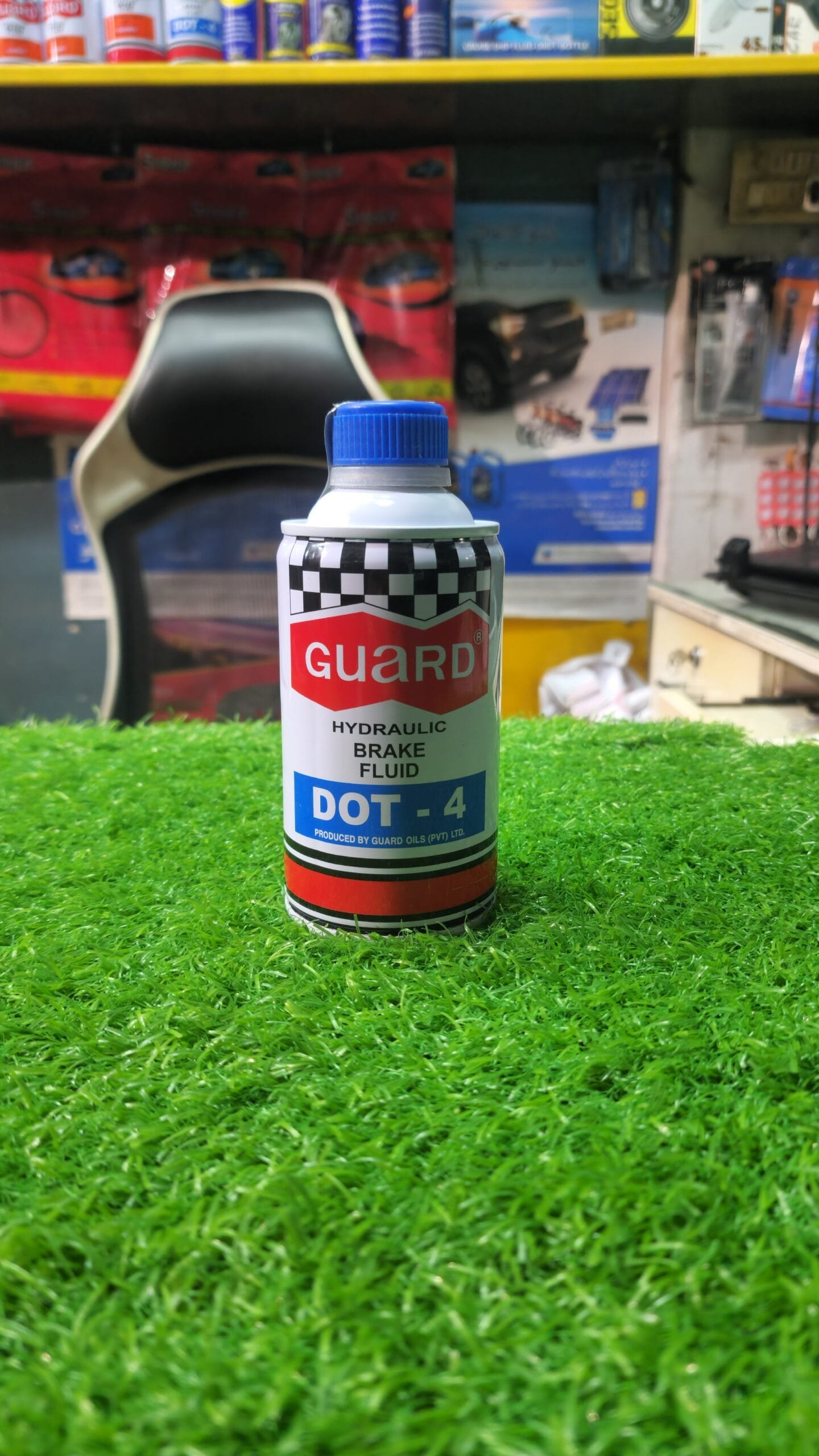
Quick answer: For almost every Pakistani car and bike, DOT 4 is the right buy. Guard DOT 4 at Rs 499 is our default at the counter; GP DOT 3 (350 ml) at Rs 499 for older cars whose cap says DOT 3 only. Change it every 2 years or 40,000 km, sooner if you do hill trips. Never top up with DOT 5.
What does DOT 3, DOT 4 and DOT 5.1 actually mean?
The DOT number is a boiling point rating, nothing more mysterious than that. Brake fluid sits in a sealed system that gets hot every time you press the pedal. If it boils, you get vapour in the line, and vapour compresses. The pedal goes to the floor.
📌 Save this. It’s the only brake fluid table you’ll need.
Swipe ← → to see the full table
| Grade | Dry boiling point (new) | Wet boiling point (3% water) | Base | Use in Pakistan |
|---|---|---|---|---|
| DOT 3 | 205°C | 140°C | Glycol | Pre-2010 cars, CD70, CG125, cars whose cap says DOT 3 only |
| DOT 4 | 230°C | 155°C | Glycol | Every modern car, ABS cars, anything that sees hills |
| DOT 5.1 | 260°C | 180°C | Glycol | Sports bikes, track use, heavy 4×4 towing |
| DOT 5 | 260°C | 180°C | Silicone | Never in a Pakistani road car. Not compatible with the others. |
The column that matters is the wet one. Glycol brake fluid pulls moisture out of the air through the rubber hoses and the reservoir cap. After about two years it holds around 3% water, and the boiling point drops by 65–75°C. That’s the number your brakes actually live with.
IMPORTANT: DOT 4 can go into any car that asks for DOT 3. DOT 3 should not go into a car that asks for DOT 4. DOT 5 (silicone) mixes with neither and turns to jelly in the ABS unit. If a bottle just says “brake oil” with no DOT number on it, put it back.
Which brake oil brands are good in Pakistan, and what do they cost?
You’ll see six or seven names on any Lahore parts shelf. Here’s how we rank them from behind the counter, with our prices on 9 September 2026. Brands marked “on order” we bring in within 1–2 days at our wholesale rate.
Swipe ← → to see the full table
| Brand | Grade | Size | Price | Our take |
|---|---|---|---|---|
| Guard DOT 4 | DOT 4 | ~450 ml | Rs 499 (BOT) | Local, consistent, sealed. Our default for Suzuki, Honda, Toyota. |
| Guard Heavy Duty DOT 3 | DOT 3 | 250 cc | Rs 280 (BOT) | Bikes and pre-2010 cars. One bottle does a CG125 twice. |
| Guard Heavy Duty Jumbo | DOT 3 | 450 cc | Rs 499 (BOT) | Full flush on an older car in one bottle. |
| GP Brake Oil DOT 3 | DOT 3 | 350 ml | Rs 499 (BOT) | General Petroleum. Clean spec, good for Mehran, Cultus, old-shape Alto. |
| Toyota Genuine DOT 3 | DOT 3 | 500 ml | Rs 850–1,100 (BOT, on order) | Fine, but you’re paying for the badge. DOT 4 above does more. |
| Honda Genuine DOT 4 | DOT 4 | 500 ml | Rs 950–1,300 (BOT, on order) | Good fluid. Same boiling point as Guard DOT 4 at 2–3× the price. |
| Motul DOT 5.1 | DOT 5.1 | 500 ml | Rs 2,200–2,800 (BOT, on order) | Only if you ride a 600cc bike or drive a Revo loaded up Naran. |
| Liqui Moly DOT 4 | DOT 4 | 500 ml | Rs 1,500–1,950 (BOT, on order) | Excellent, imported, hard to find sealed. Check the batch code. |
Notice something. At the DOT 4 level, the boiling point is set by the standard, not the brand. A Rs 499 DOT 4 and a Rs 1,300 DOT 4 both have to clear 230°C dry. What you’re paying extra for is packaging, import duty, and sometimes a longer shelf life. For a Cultus that gets a flush every two years, that extra Rs 800 buys nothing you’ll feel at the pedal.
What happened on the Murree road in July
19 July 2026. Usman bhai, Corolla 2014, 138,000 km, five people and luggage on the way down from Patriata. Halfway down, the pedal went soft, then long, then to the floor. He got it stopped on the handbrake and a low gear, and rang us from the roadside because he’d had an oil change with us the month before.
His brake fluid was original. Twelve years, never touched. Dark brown, and when we tested it back in Lahore the wet boiling point had dropped to about 120°C. Twenty minutes of downhill braking took the discs past that. The fluid boiled.
The fix was two bottles of Guard DOT 4, Rs 998, and a bleed. The alternative, if the handbrake hadn’t held, doesn’t have a price we want to write down.
This is the exact mistake we warned about before the summer trip season:
How do you know your brake oil is already bad?
You’re probably thinking you’d feel it. You won’t, not until a long descent. Two checks that take a minute in the driveway:
Colour. Open the bonnet, find the small reservoir on the driver’s side firewall (it usually says DOT 3 or DOT 4 on the cap). New fluid is clear to pale yellow, like cooking oil. Tea-coloured means it’s absorbed water and it’s oxidising. Coffee-coloured means change it this week.
Age. If you can’t remember it being changed, it hasn’t been. Most Lahore cars we open have never had a brake fluid flush. Ever.
TIP: A Rs 600 brake fluid tester pen (the ones with three LEDs) reads water content in five seconds. Under 2%, fine. 3%, change soon. 4% or more, don’t do a hill trip until it’s flushed. We keep one at the counter, bring the car and we’ll check it free.
How often should brake oil be changed in Pakistan?
The manual says two years. In Lahore, with humidity sitting at 70–80% from July to September, we’d say two years is the ceiling, not the target.
Daily city car: every 2 years or 40,000 km, whichever comes first. Hill trips every summer: before the first trip, every year. Bikes (CD70, CG125, YBR): every 18 months, front disc especially. Car that’s been parked a year: change it before the first drive. Sitting still, the fluid still drinks moisture.
A full flush on a car takes 450–600 ml. That’s one Guard DOT 4 Jumbo, or two 250 cc bottles. Budget Rs 500–1,000 for fluid and, if you’re not doing it yourself, Rs 500–800 for a proper four-wheel bleed at a decent workshop.
Where we personally refuse to compromise
We sell engine oil at every price point and we’ll happily argue that a Rs 4,299 mineral oil is right for a Mehran (we set out why in our synthetic vs mineral guide). Brake fluid is different. We won’t sell an unmarked bottle, we won’t top up a reservoir with a different DOT grade than what’s in it without flushing, and we’ll never put DOT 5 silicone in a road car, even if the customer insists. The fluid is Rs 499. The thing it protects isn’t.
Bottom line
- Buy DOT 4 for any car made after 2005 and any car that goes to the hills. DOT 3 for older cars and bikes whose cap says so. Never DOT 5.
- Brand matters less than the seal and the DOT number. Guard DOT 4 at Rs 499 meets the same 230°C standard as fluids at Rs 1,300.
- Change it every 2 years or 40,000 km. If it’s tea-coloured, or you can’t remember the last change, do it this week.
Tonight: open the bonnet, shine your phone torch on the brake reservoir, and take a photo of the fluid colour and the cap. Send it to WhatsApp 0328-4500975 with your car model. We’ll tell you whether it’s fine, due, or dangerous, and which bottle to buy.
Frequently asked questions
What is the brake oil price in Pakistan in 2026?
At our counter, local DOT 3 and DOT 4 runs Rs 280 to Rs 499 a bottle (Guard, GP). Imported and genuine brands are Rs 850 to Rs 2,800 for 500 ml at our wholesale rate, brought in within one to two days.
A full flush on a car needs 450 to 600 ml, so budget Rs 500 to Rs 1,000 on fluid and Rs 500 to Rs 800 for a proper four-wheel bleed.
Can I use DOT 4 brake fluid instead of DOT 3?
Yes, and it is usually an upgrade. DOT 4 has a higher boiling point, 230°C dry against 205°C, and it is fully compatible with DOT 3 systems.
The reverse is not safe. Putting DOT 3 into a car that specifies DOT 4 lowers your margin on long descents.
What happens if I mix DOT 3 and DOT 4?
Nothing dramatic. Both are glycol-based and they mix without damaging anything. What you end up with is a blend whose boiling point sits closer to the DOT 3 fluid, so you lose the margin you paid for.
For a top-up on the road it is fine. At the next service, flush the system and fill with one grade.
DOT 5 is the exception. It is silicone-based, mixes with neither, and turns to jelly in an ABS unit. Never put it in a road car here.
Can I put DOT 3 in a DOT 4 system?
Only as an emergency top-up to get home. DOT 3 boils about 25°C lower when new and roughly 15°C lower once it has taken on water.
On flat Lahore roads you may never notice. On a long descent from Murree or Naran, that gap is exactly where brake fade starts.
Will DOT 3 give less braking power than DOT 4?
Not in normal driving. Brake fluid does not change how hard the pads bite; it transmits your pedal pressure to the callipers.
The difference shows under sustained heat. When fluid boils it turns to vapour, vapour compresses where liquid does not, and the pedal goes long and then to the floor. That is when DOT 4 earns its price.
How often should brake fluid be changed in Pakistan?
Every 2 years or 40,000 km for a daily city car, whichever comes first. Before the first trip of the year if you drive to the hills. Every 18 months for bikes with a front disc.
Lahore humidity sits at 70 to 80 percent from July to September, and glycol fluid pulls that moisture in through the hoses and the reservoir cap. Two years is the ceiling here, not the target.
How do I know if brake oil needs changing?
Open the bonnet and look at the reservoir on the driver-side firewall. Clear to pale yellow is healthy. Tea-coloured means it has taken on water and is due. Dark brown means change it this week.
If you cannot remember it ever being changed, it has not been. Most Lahore cars we open have never had a brake fluid flush.
Can brake oil cause brake failure?
Yes, and it is the most common cause we see on the Murree and Naran roads. Fluid holding 3 to 4 percent water boils at around 120°C to 140°C instead of 230°C.
Twenty minutes of downhill braking takes the discs past that, vapour forms in the lines, and the pedal drops to the floor. Two bottles of Guard DOT 4 at Rs 998 and a bleed prevents it.
Share this with anyone planning a hill trip this year.
How this was verified: written on the Butt Oil Traders shop floor at 17 KM Ferozepur Road, Shami Auto Market, Lahore. We have stocked brake fluid since 1999 and flush it on the cars we service. BOT prices are our shelf prices on 9 September 2026; “on order” prices are our wholesale rates for brands not kept on the shelf. Boiling points are the FMVSS 116 minimums for each DOT grade.